
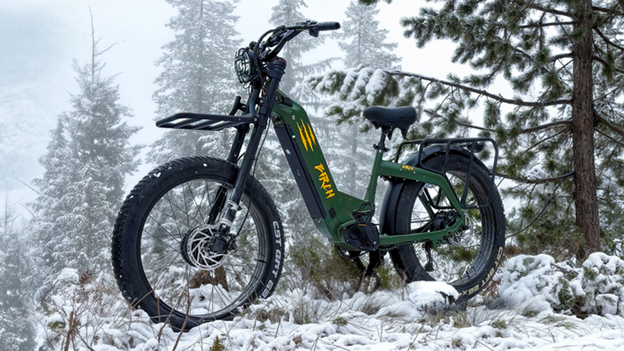
With a Birch Peak 2400W, you have more power at your fingertips than almost any other hunting e-bike on the market. With 160Nm of torque and a dual-motor system, it’s tempting to think you can just “throttle and go” without ever touching your mechanical gears.
However, understanding how to sync your bike’s mechanical gears with its electric motor levels is the secret to unlocking maximum range, preserving your motor’s life, and conquering the steepest backcountry terrain.
Here is your guide to mastering the transmission on your Birch hunting electric off road bike.
Table of Contents
1. The Basics: Mechanical Gears vs. Pedal Assist (PAS)
Think of your e-bike as having two separate “transmissions”:
- The Mechanical Gears: These are the physical gears on your rear wheel (the derailleur and chain). They control how hard it is for you (and the motor) to turn the rear wheel.
- Pedal Assist (PAS) / Throttle: This is the electrical power. Higher levels give you more “oomph” from the dual motors, regardless of which gear you are in.
The Golden Rule: Use your mechanical gears for terrain (hills vs. flats) and your PAS levels for effort/speed.
2. When to Shift: A Quick Guide
| Terrain | Mechanical Gear | PAS Level | Why? |
| Starting from a stop | Low (Large Cog) | 1–2 | Makes it easier to get the heavy payload moving without straining the motor. |
| Steep Hill Climbing | Lowest (Largest Cog) | 4–5 (AWD) | Maximizes torque. Lets the motor spin at a high, efficient RPM instead of “lugging.” |
| Flat Pavement | High (Smallest Cog) | 2–3 | Allows you to reach higher speeds (20+ mph) without your legs spinning like a windmill. |
| Deep Mud/Sand | Mid-Low Gear | 5 (AWD) | Keeps the wheels turning steadily with high torque to prevent sinking. |
3. Pro-Tips for Shifting with Dual Motors
Because Birch bikes utilize a high-torque 1500W rated dual-motor system, you have to be more intentional about your shifting than you would on a standard electric mountain bike.
Shift Before the Hill
This is the most important rule for hunters. If you see a 30% incline approaching, shift down to a lower gear before you start climbing. Shifting while the chain is under the massive tension of 160Nm of torque can cause the chain to “pop” or even break.
Ease Off the Pedal
When you click the shifter to change gears, pause your pedaling force for a fraction of a second. This allows the chain to slide smoothly onto the next cog without fighting against your leg power and the motor’s power simultaneously.
Don’t “Cross-Chain”
Try to keep your chain as straight as possible. While most Birch models use a 1x drivetrain (one gear in the front, multiple in the back), if you feel the chain vibrating or making a grinding noise in the lowest or highest gear, you may need a quick derailleur adjustment to ensure a clean line.
4. Why Gears Matter (Even with 2400W of Power)
You might ask: “If I have a throttle and 2400W of peak power, why do I need to shift at all?”
- Battery Efficiency: Riding in a high gear up a steep hill forces the motor to draw massive amounts of current, which drains your battery fast. Shifting to a lower gear lets the motor work more efficiently, extending your $85$-mile range.
- Motor Health: “Lugging” the motor (using a high gear at a low speed) creates heat. By using your gears correctly, you keep the motor running cool, ensuring your Birch lasts for years of rugged use.
- The “Stealth” Factor: A motor working in the correct gear is much quieter. If you are trying to sneak into your hunting spot, a high-RPM, low-load motor is your best friend.
5. Using the Birch 4-Mode Drive System with Gears
One of the unique advantages of a Birch is the ability to switch between AWD, FWD, RWD, and Adaptive modes.
- In AWD Mode: Your mechanical gears only affect the rear motor. The front motor provides a steady pull regardless of your gear. This is why AWD is so effective—even if you’re in the “wrong” gear in the back, the front motor helps pull you through.
- In Adaptive Mode: The bike’s brain monitors your pedaling. If you are in a gear that’s too high for the hill, the bike will sense the strain and automatically engage the front motor to compensate.
Practice Makes Perfect
The best way to learn your gears is to take your Birch out on a local trail before your big hunting trip. Practice shifting while transitioning from flat ground to a climb, and get used to the “sweet spot” where your legs and the motors are working in perfect harmony.
When you master your gears, you’re not just riding a bike—you’re operating a high-performance, all-terrain machine.