For many e-bike riders, the battery used to be a black box: charge it, ride it, and hope it lasts. In 2025 that’s changing fast. As electric bicycles become more powerful, more common and more expensive, riders — from daily commuters to performance-minded weekenders — are demanding visibility into the single most critical component of their machine: the battery. That demand has pushed battery management systems (BMS) out of the engineering lab and into the rider’s app screen, dashboard and dealer service bay. Here’s why battery health monitoring is no longer a niche feature but a rider expectation — and why BMS visualization is the next mainstream shift.
Table of Contents
Riders Want Full Control Over Their Ride
One of the biggest concerns for e-bike riders has always been the fear of unexpected breakdowns, and more often than not, the root of that worry lies in the battery. Whether it’s a sudden drop in charge or a malfunctioning cell, riders have traditionally had no way of knowing the true condition of their battery until it’s too late. This lack of visibility creates stress, limits the confidence to ride longer distances, and can even lead to costly repairs or replacements. Fortunately, the latest advancements in battery technology have dramatically changed this scenario. Modern e-bikes are now equipped with intelligent Battery Management Systems (BMS) that allow riders to monitor the health, charge level, and performance of their battery in real time. With these systems, users can see not only the current state of charge but also the overall health of individual cells, temperature fluctuations, and even potential issues before they become serious problems. This real-time insight transforms the battery from a “black box” into a transparent, manageable component, giving riders peace of mind, improving safety, and allowing them to fully enjoy their riding experience without the constant fear of unexpected battery failure. In short, intelligent BMS technology has turned one of the most common sources of anxiety for e-bike riders into a feature that enhances both performance and confidence on the road.
Fleet Operators and Commuters Treat Batteries like Assets
For bike-share operators, last-mile delivery fleets, and commuter programs, batteries aren’t consumables — they’re capital assets. Tracking battery health centrally saves real money. If a fleet manager can flag underperforming packs early, they can reallocate or retire cells in a planned way, avoiding emergency downtime and preserving resale value.
This operational shift has helped drive investment into smarter BMS systems and cloud dashboards — and it’s one reason the BMS market is growing rapidly. Analysts estimate the global BMS market is expanding at double-digit CAGR as electrification and connectivity converge.
Rider Safety First: Real-Time Battery Monitoring in Action
Safety is always a top priority for e-bike riders, and the battery — as the heart of the system — plays a crucial role in ensuring it. Lithium-ion chemistry offers excellent energy density and performance, but it also comes with inherent risks: overheating, overcharging, over-discharging, or even cell failure can, in extreme cases, lead to fire or explosion. While no technology can completely eliminate these risks, modern advancements in battery management systems (BMS) have brought a significant leap forward in rider safety. Intelligent BMS modules continuously monitor key parameters such as cell voltage, current flow, and temperature, detecting any anomalies before they become serious problems. Features like overcharge protection, over-discharge prevention, and thermal management allow the system to automatically intervene, whether by reducing power output, temporarily shutting down the battery, or alerting the rider through an app or onboard display. This real-time monitoring transforms the battery from an unpredictable “black box” into a transparent, manageable component, greatly reducing the likelihood of accidents. As a result, riders can focus on enjoying their journey with peace of mind, knowing that their e-bike is equipped with a sophisticated safety net that actively protects both them and their battery. The combination of BMS intelligence and proactive safety measures marks a major milestone in making e-bike riding not only more convenient but also significantly safer.
Smart Battery Monitoring for Longer E-Bike Life and Reliable Performance
The visualization of e-bike batteries allows riders to gain clear, real-time insight into the battery’s condition, which in turn helps them maximize both the lifespan of ebike battery and overall usage. By monitoring parameters such as state of charge, temperature, and individual cell health, riders can adopt more efficient charging habits, avoid over-discharge, and prevent excessive heat buildup—common factors that reduce battery longevity. This level of transparency transforms the battery from a “black box” into a manageable asset, enabling riders to take proactive measures that extend its usable life. Over time, consistent monitoring not only preserves capacity and performance but also enhances safety, reliability, and the overall riding experience. With intelligent battery visualization, users can enjoy longer rides and more predictable performance, making the battery a sustainable and trustworthy component of their e-bike.
Advances in SOH Estimation Make Visualization Meaningful
A visible gauge is only useful if it reflects reality. Over the past decade, research into State of Health (SOH) and online estimation techniques for lithium‑ion batteries has matured substantially. Academics and industry engineers have developed both model‑based and data‑driven algorithms that analyze voltage, current, temperature history and impedance signatures to produce reliable SOH estimates — even on constrained embedded hardware typical of modern e‑bike battery management systems (BMS).
For example: one recent study combined electrochemical impedance spectroscopy (EIS) with a lightweight equivalent‑circuit model and a machine‑learning estimator. The results achieved an average error under 2% in SOH prediction, demonstrating that such methods are accurate and efficient enough for real‑time applications.
That accuracy is a game‑changer. When SOH metrics correlate reliably with actual capacity fade and internal resistance increase, riders and fleet operators begin to trust the readouts. As a result, these indicators are increasingly being used to guide purchasing decisions, charging habits, maintenance scheduling, or deciding when to replace a battery pack — turning battery monitoring from guesswork into a reliable, data‑driven feature.
Connected BMS and Cloud Dashboards = Continuous Lifecycle Value
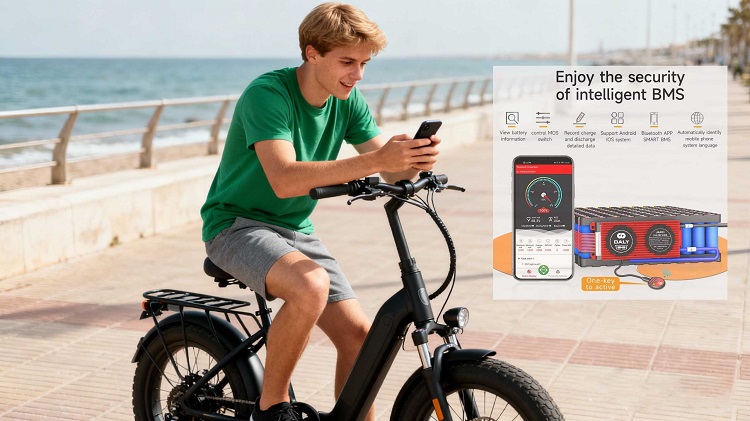
BMS visualization used to be a local feature — a tiny LED or a vague battery icon on an LCD. Today’s systems connect via Bluetooth, CAN or cellular, pushing telemetry to cloud dashboards. That connectivity supports over-the-air software updates, historical trend charts and predictive maintenance alerts.
For example, a rider’s app may show a 3-month SoH trend, estimate remaining useful life, and recommend a charging profile that maximizes longevity. For OEMs and service networks, the aggregated anonymized telemetry becomes gold: it informs next-generation designs, warranties and recall decisions. The combined effect is that the initial value of a battery increases because riders and technicians can extend its practical service life through informed action.
Better user Interfaces Turn Technical Data into Useful Actions
One reason adoption of battery monitoring lagged in the past was presentation. Raw voltages and abstract percentages didn’t tell riders what to do. The current wave of BMS visualization projects focuses on UX: clear color coding, simple advisories (e.g., “Charge slower overnight to extend life”), contextual tips tied to riding style, and actionable maintenance prompts.
Good UI reduces cognitive friction: riders don’t need to be engineers to interpret the data. Instead of an alarm that demands a service appointment, a well-designed app might recommend a quick cell balancing cycle or a different charging profile, keeping the bike on the road.
Environmental and Economic Incentives Align
Sustainability pressures are also nudging riders and manufacturers toward monitoring. Extending battery life reduces waste and the embedded carbon footprint of replacements. Consumers who are environmentally conscious — a sizeable subset of e-bike buyers — welcome tools that help them minimize resource usage.
From an economic perspective, a pack that retains usable capacity for another 20–30% of its lifetime delays a costly replacement. For daily commuters, that value compounds quickly. Consequently, the ability to visualize health and make lifespan-extending choices has become a selling point in its own right.
Third-party Ecosystems and Aftermarket Services
As BMS telemetry opens, third-party services have started to emerge: independent diagnostic tools, optimized charging stations, and aftermarket BMS upgrades. Much like a car owner bringing a vehicle into a specialist for tuning, advanced riders and fleets are beginning to pay for deeper diagnostics, performance tuning and replacement strategies informed by historical BMS data.
This ecosystem activity further validates the rider demand: where there’s actionable data, services follow.
The Role of Standards and Interoperability
For mass adoption, standards matter. Interoperable telemetry formats and protocols let different manufacturers’ dashboards and third-party apps speak the same language. Industry efforts toward standardizing battery telemetry and BMS interfaces are underway, which will accelerate the proliferation of rider-facing monitoring tools and reduce vendor lock-in.
What this Means for Riders and for OEMs
For riders: demand BMS visibility. When shopping, ask whether the bike’s app shows SoH trends, cell imbalance events and temperature history. Those features are not just “nice to have” — they’re practical tools that protect your investment and your safety.
For OEMs and pack makers: invest in transparent, accurate visualization. A trustworthy BMS that surfaces useful guidance can be a differentiator and reduces warranty costs through preventive maintenance. Companies that couple robust SoH estimation algorithms with clear UX win both riders’ trust and operational efficiency.
Companies across the e-bike supply chain are already responding. BMS market growth reflects not only electrification but also a shift toward connected, transparent battery systems that riders and fleet operators can rely on. Grand View Research And the underlying technical literature confirms the feasibility and growing accuracy of SoH estimation methods that make those visualizations meaningful.
The Rise of Visualized Lithium Batteries: A Major Trend in the E-Bike Market
The growing demands of riders and the sheer size of the e-bike market have prompted an increasing number of bicycle manufacturers to adopt visualized lithium batteries as part of their standard offerings. As riders become more aware of battery performance, longevity, and safety, manufacturers are responding by equipping e-bikes with advanced, intelligent battery systems that provide real-time monitoring and actionable insights. This trend is not just a niche innovation—it reflects a broader market shift toward smarter, safer, and more reliable e-bikes. Advanced lithium batteries with features like cell-level monitoring, temperature control, and overcharge protection are gradually becoming the industry standard, giving these high-tech packs a growing share of the market. As a result, riders benefit from improved safety, longer battery life, and more predictable performance, while manufacturers strengthen their competitive edge in an increasingly technology-driven industry. In short, the adoption of intelligent, visualized lithium batteries is shaping up to be one of the most significant trends in the e-bike market today.
Conclusion
Riders are shifting from passive users of battery energy to active managers of battery health. Visualization—clear, accurate and actionable—bridges the gap between complex electrochemistry and everyday riding choices. As BMS algorithms improve and connectivity becomes ubiquitous, the old “black box” battery will be replaced by a transparent asset: trackable, optimizable and safer. That’s good news for riders, fleets and the planet.